Tabs

Wednesday, September 24, 2014

Enjoy Los Angeles County Fair this Thursday 9/25 and Friday 9/26 on an educational fieldtrip before it closes on September 28, 2014

LA County Fair ends on August 28 this year, but the last day to go on an educational fieldtrip is this Friday, September 26.  But Thursday, September 25, happens to be a LAUSD non-instructional day, so join us on either Thursday or Friday for a free educational fieldtrip to LA COUNTY Fair with free admission and free parking.  Please contact me at reallykf@gmail.com if you would like to join us and can arrive between 9am to 11.30am before the educational entry gates are closed.  You may stay till closing time at 9pm  if you like. All parking details will be emailed to you if I confirm your participation.  Normal admission and parking costs can be found here:  http://www.lacountyfair.com/visit/get-started/ and if you have to go on another day, use promo code: AS110025 at http://sales.ticketcostars.com/lacf/Fair/tabid/1654/Default.aspx and save $7 on adult tickets.  Parking is normally $15 per vehicle.

We have been going to LA COUNTY FAIR almost every year, and, each year, there are new exhibits to add to our old favorites from the animal farms, railroad models and miniature trains, barn races, art exhibits and students' winning entries, horse-racing and horse shows, and, of course, all the goat-milking (which you can also do) and cow-milking demonstrations and acrobatic and entertaining shows.  We like to do the educational exhibits and farm shows or see blacksmiths and leathersmiths at work in the Heritage Mission in the morning before the public comes in at 11am, and then stay cool with inside art and car exhibits at the NHRA Motorsports Museum (free if you are with an educational fieldtrip) and acrobatic shows (this year, it is a Beijing troupe) within the shopping malls before doing rides when the sun is down and catch the evening shows such as  before going home ... and it is the only place we get huge barbecued turkey legs to share :)

Here is a downloadable map or you can get a hard copy as you enter:  http://www.lacountyfair.com/wp-content/uploads/2014/09/2014LACF_GroundsMap.pdf
and here are schedule of shows for both  this Thursday and Friday so you can play your day and minimize backtracking:


Some Thursday excerpted schedules give you a sense of what you do at the Farm areas:

Aunt Cindi & Uncle Bob Ice Cream & Butter ALL DAY
Five-acre farm of specialty crops ALL DAY 
Extreme Equine Show 11:30 AM, 2:30, 4:30, 8 PM 
Barnyard Racers 1, 3, 5, 7, 9 PM
Magic Farm Science Show 1:30, 3:30, 5:30, 7:30 PM 
Chicken & Rabbit Talks 2:30, 6, 8 PM 
Thummer, Daisy & Lily Meet & Greets 
5:45, 6:45, 7:45 PM

ESMERALDA’S TRAVELING CIRCUS
presented by Circus Circus 

Circus School ALL DAY (you can learn how to juggle here!)
Esmeralda’s Traveling Circus ALL DAY
This End Up 1:30, 3:30, 7 PM
Aerial Arts Circus Show 2, 4, 6, 7:30, 9 PM
Venardos Circus 2:30, 6:30, 8:30 PM
Conjurer 3, 6, 8 PM
Mango and Dango 3, 8 PM (funny action comedy)

You might not expect to see underwater creatures, but  some of these shows are well worth seeing:

BENEATH THE SEA: AN UNDERWATER ADVENTURE
Beneath the Sea ALL DAY
Live Stingray Encounter ALL DAY
Sea Lion Splash 2:30, 6, 9:30 PM
Mermaid Linden 3, 4, 5, 6:30, 7:30, 8:30 PM
Live Shark Encounter 3:30, 7, 9 PM

Below are links to all the educational exhibits, and the new featured exhibit this year is:  Hall of Heroes and Luminasia.

http://www.lacountyfair.com/play/whats-new/

http://www.lacountyfair.com/play/hall-of-heroes/

Here's a description from the link above about the Hall of Heroes:

Your adventure begins at the “Identification Station” where you learn about the various kinds of Superpowers. You then travel through our towering Cityscape and into the various Galleries of Power. They are: “Powers of the Body”, “Powers of the Mind”, “Elements”, “Mastery”, Real Life Heroes”, Gadgets”, and the “Superhero Gallery”. In each gallery you will find dramatic artwork and interactive devices demonstrating the real life forces employed by your favorite Superheroes.
In Powers of the Body you can learn about radiation from a very angry Hulk, and test your strength, balance, and senses,  under the watchful eyes of Superman. Have your brain scrambled by the puzzles of the Riddler in Powers of the Mind. Test your reflexes and your skills with magic in Mastery. Elements will expose you to the shocking secrets of a Tesla Coil, and let you walk into a Tornado Chamber.
In Gadgets you can check out Dr. Who’s Tardis, and another iconic Time Travel vehicle, the DeLorean Time Machine from Back to the Future (don’t forget your Flux Capacitor). Batman is there with his cool Batcycle from the 1960s, although he is not happy about being given a ticket by a CHIPS Officer. Iron Man and Optimus Prime are also present, as a couple of examples of the ultimate in Gadgets. Across the hall in the Superhero Gallery is an assortment of Superhero Fine Art, along with Rubbings and Coloring Stations allowing you to create your own Superhero Art."
LUMINASIA is completely new and there is an additional fee to enter, and here is a description from the website:

Luminasia "lights up LACF’s hillside with a spectacular, larger-than-life Asian themed and whimsical lanterns. Each is hand-crafted and custom built using an ancient art form and 100 artisans from China. No exhibition of its kind has ever been seen in California, and it’s only here at LACF."

To see how Luminasia was planned and structures were created, see this link: https://www.youtube.com/watch?v=PNaXGV6OeRY

To see what it looks like at the fair, here's a preview:
https://www.youtube.com/watch?v=WyypRF9_5Uk
Luminasia admission fees:
Adult Admission(ages 18+) $9.00
Child Admission(ages 6-17) $5.00
Child Admission(ages 5 and under) Free

Most schools are unable to stay more than a few hours, but if you drive your own children or carpool with others, you can stay till closing time at 9pm if you arrive with an educational group between 9am and 11.30am.  It is a long day at the fair, but if you keep cool and rest in between walking and sit-down shows, it is completely doable even with kids :)

Other tips from many years of going to the fair:

Click on your specifc day to see the schedule of educational and entertaining shows for the day and many shows are presented twice or more a day. Allow extra time for children to go slower and enjoy what they see along the way.   However, if you have never been to the fair before, it is a good idea to plan out your route based on performance shows or demonstrations you want to catch. You can do that ahead of time with this online interactive map in the blue box above.

It is always hot at the fair, so plan any rides for after the sun has gone down when it is cool,  Bring hats and sunglasses and sunscreen ...and have plenty of water bottles.  I know there is good ice-cream opposite the cow-milking areas.

My best tip for managing the heat is to alternate between outdoor activities and indoor events in air-conditioned buildings - the art gallery, car museum and all the shopping areas as well as the garden/flower buildings.  Look at the map to see where things are and look at the schedule to see what times you want to be in a certain areas. 

Bring these to cool off:  a light-weight baby-stroller (lighter than a wagon) even if you don't have a toddler so you can carry ice-cold frozen waterbottles without breaking your back as well as any healthy snacks (although the turkey legs is really something if you are not vegetarian!).  Neckerchiefs or even paper towels that you can wet to cool off around the necks, or handheld battery-operated fans, or the watermisters for fun cooling,  

 When you first enter, you will be near Fairview Farms and you can see prize-winning 4-H animals, bee-exhibits and you can hang out near the FarmViews and Heritage Farm and Crafts earlier in the day if you are interested in all the animals' exhibit (don't miss the cow-milking by machine, goat-milking by hand, and pig races), and the air-conditioned America Kids Building where you get your read-to-ride tickets in the morning. For the horse lovers, you can see some horse shows near the farm area and you can also see real horse racing at the fair .. another place to cool off and rest :)

Oh, if your kids want to earn some free junior ride tickets for up to 8th grade, you can get up to 6 free tickets-to- ride by printing out this form:

http://www.lacountyfair.com/wp-content/uploads/2014/04/2014_ReadToRideProgram.pdf

By listing the titles of books your child have read this summer and making pictures reports (K-2nd) about them or brief book reports between 25-50 words depending on their grade.  They can type or write them .. and the retired teacher volunteers would sometimes ask them about the books they read  :) Bring the form and "book reports" to the counter near the entrance at America Kids and get the read-to-ride tickets.  This building also has all the winning art work worth looking at and also dress up and play areas.  See if your child's favorite books have special features and activities here .. don't miss the Magic Tree House Stage for some action:)

Wells Fargo provided a new educational resource on financial education called Hands-On Banking at different grade levels:

http://www.handsonbanking.org/htdocs/en/t/

To organize a trip for next year, here's where you can find Fairkids fieldtrips info: 


For curriculum connections, click on each topic below:

Field Trip Resources

============================
The official address of the fair is:
1101 W McKinley Ave
Pomona, CA 91768

But Gate 9 in the BLUE GATE area is off WHITE AVE if you are doing a homeschooler/private school fieldtrip.

is a good map to orient yourself and you can see WHITE AVE and GATE 9 as well as the freeways.
I would gps the intersection of McKinley and White Ave unless you see a closer route from the freeway you are taking.  This map is interactive so you can click on each named areas.   


Thursday, September 18, 2014

Celebrate a Day of Chivalry in the Middle Ages at Getty Center's Family Festival this Saturday, September 20, 2014.

If you have never been to a Family Festival at either Getty Center or Getty Villa, come this Saturday to the Getty Center and be surprised by all you can enjoy on a themed family festival between 10 am. and 6 pm.  Admission to the Getty is always free, but parking is $15 per car and there is alternative public transportation. Trams start running by 9am and you can always pack a family picnic or purchase food in this amazing venue where art, music, story-telling, live demonstrations, gardens, and architecture can be appreciated in a Family Festival.   The schedule below for the day's event allows one to plan your day between performances, art projects, and the galleries.  Don't forget to check out Chivalry exhibit that inspired this family festival.

As a special note, if you become interested in the historical sword fighting in the German medieval tradition after seeing the combat exhibition and other demonstrations by members of the Academy of Arms, check them out at: http://www.academyofarms.com/ and ask the demonstrators for more information.  My son is one of their enthusiastic apprentices and will be one of those teaching lessons at the festival :)

"Chivalry first developed as a code of honor that emphasized bravery, loyalty, and generosity for knights at war in the 11th and 12th centuries. By the later Middle Ages illuminated manuscripts had helped establish chivalry as a system of values that permeated almost every aspect of aristocratic culture. 

This exhibition, which is drawn from the Museum's permanent collection, traces chivalry through its many manifestations—from courtship to hunting to jousting to war. With lavish illustrations celebrating the visual splendor of elite life, these manuscripts played a central role in promoting the tenets of chivalry, many of which have shaped the values of our own culture."  See the nice video introduction from this link:

http://www.getty.edu/art/exhibitions/chivalry/

Let’s remake chivalry for the 21st century is part of the Chivalry Project.
Check out this digital rulebook of chivalry written by our contemporaries and respond to medieval rules and add a new rule of your own. The next free workshop at the Getty Center will be on: Saturday, November 1, 2014

http://thechivalryproject.org/

Finally, don't forget to bring your address book because Getty Center will post for you any postcard you decorate or write to any part of the world.  Don't miss the hidden cactus garden and have your younger children explore the family room :)

http://www.getty.edu/visit/
http://www.getty.edu/visit/exhibitions/
http://www.getty.edu/visit/center/art.html


The Competition in Sittacene and the Placating of Sisigambis (detail), about 1470–75, Master of the Jardin de vertueuse consolation and assistant. Tempera colors, gold leaf, gold paint, and ink on parchment. The J. Paul Getty Museum, Ms. Ludwig XV 8, fol. 99

 Chivalry in the Middle Ages


Date: Saturday, September 20, 2014
Time: 10:00 a.m.–6:00 p.m.
Admission: Free; no reservations required.
Travel with your imagination to the age of chivalry in this daylong festival celebrating knights in armor, ladies of the court and all things noble, inspired by the exhibition Chivalry in the Middle Ages. Listen to tales of Arthur's Round Table and deeds of great bravery through age-old stories and myths. Watch as a master blacksmith demonstrates how to forge a suit of armor, design a family coat of arms, and decorate a goblet for your own royal feast. 

 
MUSEUM COURTYARD STAGE 

Les Enfans Sans Abri - A Knight To Remember: The Chivalrous Tale of Gillion de Trazegnies
11:15–Noon and 2:30–3:15 p.m.

A tale of a noble knight who makes a vow to his new bride that takes him far from home and the adventures (and misadventures) this promise gets him into. When the two finally meet up again fifteen years later... each has quite a surprise for the other! 


We Tell Stories - The Chivalry of Knights and Samurai
1:00–1:45 p.m. and 4:15–5:00 p.m.

With their signature sense of humor and audience participation, We Tell Stories will examine the chivalric code—Honor, Valor, and Devotion—through stories from the court of King Arthur to the ancient dynasties of Japan. 

STROLLING 

Music of the Middle Ages
Noon–4:00 p.m.
Members from the USC Collegium perform festive songs and dances of the Middle Ages and Renaissance, played on lutes, guitars, recorders, and shawms by strolling minstrels. Featuring the greatest hits of the courtly jousting ear, from "rostibolli gioiso" to improvisations over Greensleeves - the birth of the four-chord progression! 
 
LECTURE HALL 

Jousting and Jesting with David Prather
12:15–1:00 p.m. and 3:30–4:15 p.m.
Chivalry is not dead! Come slay dragons, joust with knights and rescue damsels in distress—fun for the whole family! 

RESEARCH INSTITUTE GROVE 

Arms and Armor
Noon–4:00 p.m. 
Master blacksmith armorer Tony Swatton of Sword and Stone demonstrates materials and techniques used in making arms and armor of the Middle Ages. 

 
MUSEUM COURTYARD

Academy of Arms
10:00 a.m.–6:00 p.m.
Don't miss our medieval combat exhibition. Mock duels, weapon and armor displays, historical fencing lessons for children and adults, and much more! 

WORKSHOPS
10:00 a.m.–6:00 p.m. 
(last seating at 5:30 p.m.) 

Noble Goblets 
Bring the Middle Ages into our current day by making a goblet of visual splendor. Create individualized designs inspired by medieval manuscripts. 

Wave Your Arms in the Air 
Design your own coat of arms on a flag and march it around the Getty grounds. Participants will use traditional imagery and discover the meanings behind these symbols. 

Illuminated Frames 
Using a variety of gold pens and translucent papers, decorate a frame to display your postcard-sized art. 

Tuesday, June 17, 2014

See Los Angeles Ballet perform Balanchine's Serenade and La Sylphide at UCLA's Royce Hall on Saturday, June 21st, at 7.30pm


Los Angelenos will be delighted to catch Los Angeles Ballet's last performance of Balanchine's Serenade and La Sylphide in 2014 at UCLA's Royce Hall on Saturday, June 21st, at 7.30pm.

Performed to Tchaikovsky's 1880 Serenade for Strings in C, Op. 48, Serenade was created by a then 30-year old George Balanchine soon after he first arrived in the United States.  It is a complex choreography distilling strong classical ballet techniques into an ethereally beautiful and seemingly plotless piece where you can interpret the dance the way you see/feel its beauty and/or sadness.   I earlier blogged about Balanchine's musical training and only someone with his musical sensibility could choreograph a piece as if the composer could visualize a physical representation of his music:   To hear and learn more about the music, please check out these links:

https://www.youtube.com/watch?v=xsGRglp6tvs
https://content.thespco.org/music/compositions/serenade-for-strings-piotr-ilyich-tchaikovsky/

For more on Serenade as a seminal ballet work, see:

http://online.wsj.com/news/articles/SB10001424052748703467004575463543929815752 for an expansive history and interpretation of Serenade

This insightful video about dancing this ballet from the point of view of a NYC prima ballerina discusses Serenade in terms of specific major roles is definitely worth watching to see beautiful dance footage from an elevated angle that you won't see from the audience's perspective here:

https://www.youtube.com/watch?v=bBtzyRzk0UM

La Sylphide as performed by Los Angeles Ballet is a shorter version from the Royal Danish Ballet tradition with a beautiful stage set complete with stunning Scottish highland tartan and kilt costumes and character shoes while the syphs (imaginary spirits inhabiting in air) are ethereal by contrast.  Children will be especially excited to see the aerial hoisting of dancers up the chimney and through the sky.  Below is a full story line which is worth reading before seeing the show.  If you are unable to see this performance or want to see different versions of this ballet, here is a full length version of La Sylphide with a slightly different choreography by Paris Opera Ballet in 2004:

https://www.youtube.com/watch?v=450Y-8uR60E

If you have just seen Maleficent the movie, you will see a similar de-winging scene except, in this case, the hero was unwittingly the cause of the sylph's death. In one, you see a benevolent witch touched and transformed by a child's innocence; in the other, a truly maleficent witch who seeks revenge after being offended and tricks the hero into killing his enchanting love.

La Sylphide is not to be confused with Les Sylphides which was created in 1909 by the Ballets Russes where Balanchine was choreographer for before he came to the United States. Les Sylphides is considered the first plotless ballet set to the music by Chopin.  Here is a performance of Les Sylphides for comparison as performed by Mikhail Barynishkov:

https://www.youtube.com/watch?v=LBJNc3h7Hp8

Tickets for Los Angeles Ballet are available at
310-998-7782 or www.losangelesballet.org

The detailed plot summary below is from:  http://www.bolshoi.ru/en/performances/234/libretto/
and I have excerpted some hostorical details about the ballet dancer for whom La Sylphide was choreographed for.   Enjoy the performance either live or on youtube.

Synopsis

Act I
A Scottish manor-house

It is the morning of James’s marriage to Effie and he is asleep in his armchair. A winged figure, a Sylphide, is kneeling by his side. She kisses him on his forehead and he wakes up confused. Entranced by the vision of the Sylph, he attempts to capture her, but she escapes him; as she reaches the fireplace, she vanishes up the chimney. Troubled, he wakes his companions but none of them have seen her. Gurn, James’s rival, arrives and learns that James is infatuated with someone other than Effie.

The preparations for the wedding are in full swing. James hardly notices Effie; instead she is wooed by Gurn whom she ignores. James joins in the preparations but gradually realizes that, as Effie dreams more and more of the wedding, his own dreams go far beyond the walls of the manor-house.

An old woman, Madge, has slipped unnoticed into the hall to warm herself by the fire. James, sensing that she is a sinister presence, takes an immediate dislike to her and cannot bear to see her sitting where he last saw the Sylph. He orders her to leave but Effie calms him and persuades him to let Madge tell the fortunes of some of the guests. Madge prophesies that Effie will marry Gurn, and James, furious at this, threatens Madge, who curses him. Effie runs off to dress for the wedding leaving James alone and in turmoil.The Sylph once again shows herself to James, declares her love for him and tells him that they belong together, Gurn enters and, believing that he may have caught James talking to another woman, attempts to reveal the situation to Effie but failsAs the wedding festivities begin, the Sylph reappears and, unable to resist her enticements, James follows her into the forest. Effie is left broken-hearted.
Act II

A glade in the forest

Deep in the forest, shrouded in mist, Madge is planning her revenge. She makes a veil, irresistible to all in a magic cauldron. As the fog lifts, James enters with the Sylph, who shows him her realm. She brings him berries and water but evades his embrace. To lift his spirits she calls on her sisters and the forest fills with sylphs, who dance for James. Try as he might, he is unable to catch the Sylph in his arms

Effie and James’s companions reach the glade looking for him. Gurn finds James’s hat, but Madge convinces him to say nothing. He proposes to Effie and, encouraged by Madge, she accepts. Everyone leaves to prepare for the wedding of Effie and Gurn.Meanwhile, James is desperately looking for the Sylph, and Madge convinces him that the veil she has made will enable him to catch her. The Sylph appears and, seeing the veil is totally captivated by it. She allows James to place it around her shoulders and as he does so, he kisses her. His embrace is fatal and the Sylph’s wings fall to the ground. In despair James sees what should have been his own wedding party in the distance. As Madge forces him to see what he has lost, he realizes that in trying to possess the unobtainable he has lost everything.
La Sylphide is also a significant work for other reasons and here's a little history worth reading about as excerpted from:  http://www.bolshoi.ru/en/performances/234/details/

This is a work which marks a turning point in the genre: first, it is the oldest of the classical ballets which are known today, second, the ballet of the same name marks the start of dancing on pointe, third, it is not fortuitous that it was in that ballet that the ballerina — Marie Taglioni, the first ballerina of the romantic era — was to rise on pointe, the sylphide, after all, is a maiden of the air.

La Sylphide — produced by the prima ballerina’s father Filippo Taglioni — was premiered in Paris in 1832. Two years later, it was seen by August Bournonville, the man who made the name of Danish ballet, who decided to do a version of it for his Company. He did not have enough money to acquire the rights to the score but, nothing daunted, he commissioned new music from a Danish composer. And so — in 1836 — the Danish La Sylphide which was to become famous the world over, saw the light of day. And, thanks to the reverent attitude to this ballet of generation after generation of Royal Danish Ballet dancers, it has been preserved for posterity.

From http://www.vam.ac.uk/content/articles/r/romantic-ballet/, you can also read more about the romantic ballet tradition and about Marie Taglioni for whom La Sylphide was written.


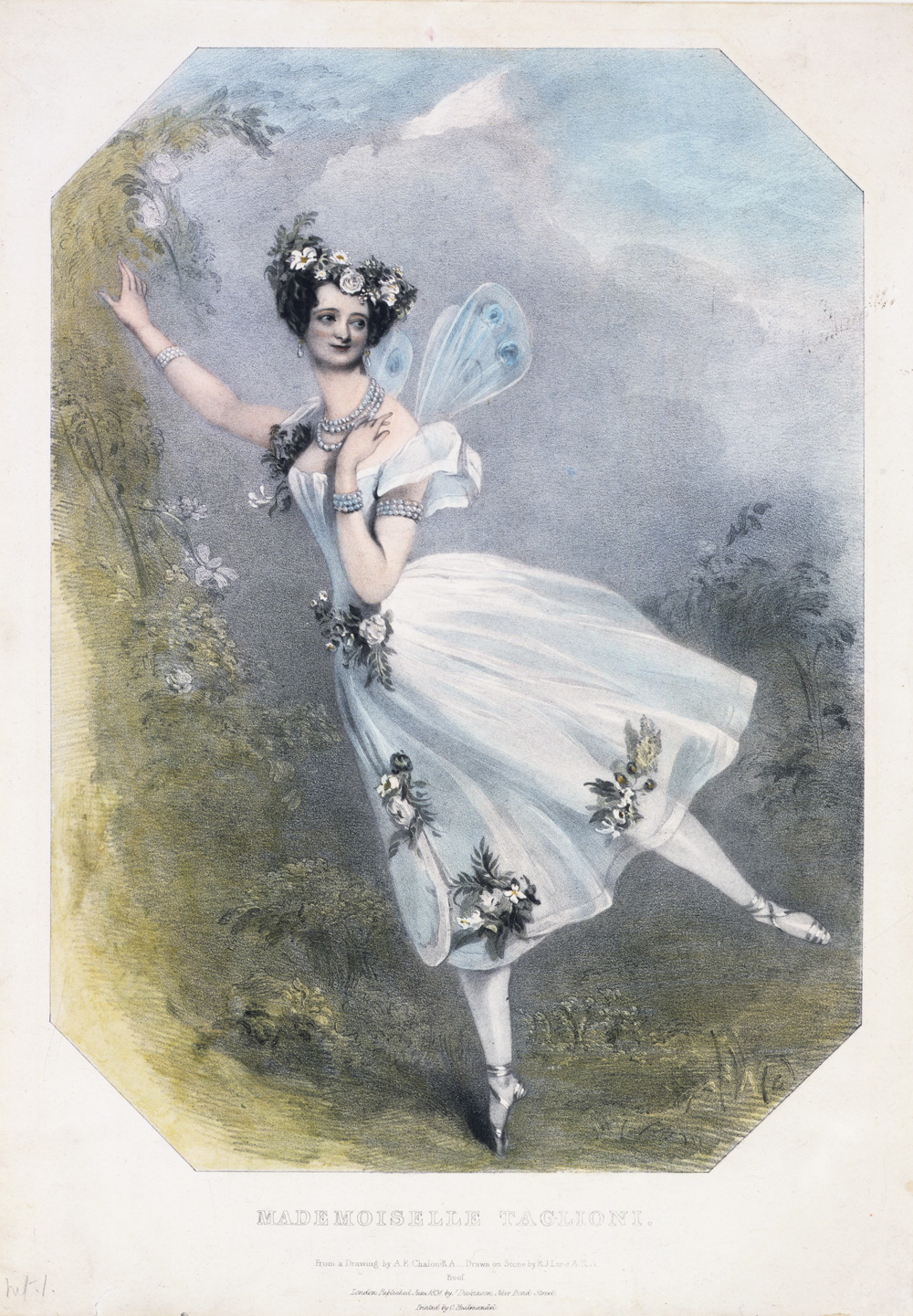
Marie Taglioni (1804 - 84) in the ballet Flore et Zephre, engraving by Richard James Lane (1800 - 72), after a drawing by Alfred Edward Chalon (1780 - 1860), hand-coloured engraving, England, 1831. Museum no. E.5055-1968

Marie Taglioni (1804 - 84) in the ballet Flore et Zephre, engraving by Richard James Lane (1800 - 72), after a drawing by Alfred Edward Chalon (1780 - 1860), hand-coloured engraving, England, 1831. Museum no. E.5055-1968

Marie Taglioni
‘Will that little hunchback ever learn to dance’ mocked Marie Taglioni’s teacher in Paris. Despite being exceptionally plain with very long arms and legs, Marie Taglioni became more than the world’s most famous dancer. Her look became the defining image of the ballerina, poised on the tips of her toes, wearing a long white tutu and a floral wreath, her dark hair parted at the centre and drawn back.
Marie Taglioni was born in Sweden into a family of dancers. She trained in Paris but was not considered talented until her father, Filippo, became her teacher. In 1832, Filippo created La Sylphide to show Taglioni to her best advantage. This supernatural, tragic story with its romantic Scottish setting, combined with Taglioni’s ethereal look, became a defining moment in Romantic ballet. Taglioni became the rage of Europe.
The ethereal image of the sylph was reflected in fashion. Young women often drank vinegar and water to make themselves look pale and interesting.
Marie Taglioni danced the title role in La Bayadère in London in 1831. Her dress was based upon conventional dance dress of the period, but the ballet's Indian setting is clear from the scoop neck, fitted short sleeves, wide belt, pearl droplet head-dress and long earrings seen in this print.
A bayadère is an Indian temple dancer. The 1830s knew little about Indian dance and the movements were based on visual sources such as books or paintings. London did not see authentic Indian dancing until 1838, and even then some spectators preferred Taglioni's 'Indian' dance to the real thing.
Taglioni stands 'en pointe' (on the tips of her toes). There are prints of dancers standing en pointe in the 1820s, but then it was not used artistically but as a technical trick. Taglioni and her choreographer father honed the technique to perfection, making it effortless and an expression of character. To her audiences, she seemed to float above the ground. From now on, point work would be an integral part of ballet technique.
of her ballet shoes was sold for 200 roubles, cooked, garnished and served with a special sauce, then eaten by a group of ballet fans. History does not record whether the shoes had been worn or not.
In England the London to Windsor stagecoach was named after her.
Taglioni retired from dancing in 1847. In 1860 she choreographed her only ballet Le Papillon (The Butterfly) for her pupil Emma Livry. Tragically, in 1863, Emma’s stage costume brushed against a gas jet and caught fire. She later died of burns.

Monday, May 26, 2014

The Pompeii exhibit at Calfornia Science Center - and more Pompeii resources from Getty Villa and LACMA


     Los Angeles is one of three American cities where you can enjoy the Pompeii exhibit and it is the only one on the West Coast!  Since I am leading three separate fieldtrip groups to see the exhibit, I decided to preview the Pompeii exhibit.  Here's what you can anticipate and some items to look for at the Pompeii exhibit.


     Located on the 3rd floor of the California Science Center, the Pompeii exhibit takes up a whole section of the floor opposite the High Wire Bicycle location.  If you come on my fieldtrips on June 6 and June 11, please meet at the pre-arranged time for the Pompeii exhibit at the area near the restrooms where there are benches to sit and wait for our timed entry into the exhibit.  We do not need to join the IMAX lines as we gather as a group to the left of the IMAX building door and enter together.  We will also get a timed reservation for the Endeavor shuttle exhibit if you would like to see it. You are allowed to take photographs without flash at the Pompeii exhibit :)

      Upon entry to the first room, there is a brief screen introduction to Pompeii just before the catastrophic eruption of Mount Vesuvius on August 24, 79, before you enter the first exhibit room.  It has almost same feel as going into an attraction at a themed park when you are pleasantly surprised by what you see when the door opens into the first exhibit room.  Free audio guides are available (upon request on weekends).  To listen in English, you press 591 and then the green GO button to activate the English version.  You will need to press 101 to about 118 and then green GO button for audio guide when you see the headphone signs on the exhibit cases.  It is not always easy to spot those numbers :)

     Except for the final post-eruption room where you see the resin casts of human forms (but no human remains of any kind are in these copies), the whole multi-room exhibit displays the artifacts and frescoes found in Pompeii with various themes featuring artifacts found when Pompeii was excavated. Some items exhibited are statues of political and religious significance recovered from Pompeii, a beautiful mosaic table, a safe, a commercial balance, pottery jars that were used for transporting wine, olive oil and the highly-prized salted fermented fish sauce they call garum, jewelry, medical, cooking, fishing, gardening and farming tools used in that period, decorated metal and ceramic dishes, and the gladiator's symbolically-decorated protective gear explored from the beautifully portrayed backdrop of various rooms typically found in Roman villas of the time of the eruption of Mount Vesuvius in AD 79.  In almost every room, there is a video screen showing visuals of what one could expect a public bath or public forum to be like.  Statues and decorative items are placed in front of mural background that gives a physical context to imagine how they are found.  You get a good sense of what Pompeii residents ate, their "fast-food"eating out places, and imagine drinking watered-down wine or fish-sauce spiced food, the bread they eat, and what home kitchens looked like.

    Parental guidance is expected  for a "brothel" room which has a video and a painting/fresco of a copulating couple that could be something you might not want a young child to see, and this room can by completely bypassed.

    Before entering the final exhibit room, you will enjoy a short simulated computerized time-lapsed images of what could have happened to a residential building from eruption to 24 hours later. This is where you will be surprised by the floor shaking and "smoke" (simulated fog) ... and you then go into the final room where the body resin casts are exhibited.  As you exit the final exhibit before the gift shop, there is a large area where children can do some hands-on activities such as building an archway :)  If, for any reason, you wish to skip this sensory experience, there is a bypass door that leads directly to the final exhibit room.

     The exhibit's artifacts are well presented with enough details to keep one well informed about Roman life almost 2000 years ago.  It is fascinating how much little have changed in two thousand years and how contemporary some of these artifacts feel.  Vivid digital video portrayals of how Pompeii homes might have used the artifacts and how the wealthy Pompeiians might have their homes decorated and lived do a great job of engaging the visitors, young and old.  Unless, of course, you are also an encyclopedic learner like me who always wants to know more.   This multi-media Pompeii exhibit renews one's appreciation of how absolutely marvelous that we have Getty Villa in Los Angeles to continuously engage us in learning more about Roman and Greek antiquity.  Getty Villa provides much much more about Greek and Roman cultures that should not be missed and should be a follow-up to this exhibit if you have not been to the Getty Villa.  If you ask Getty docents or security guards in the first atrium at the main building where the rectangular shallow mosaic pool is, they will tell you that that "sky-window" is indeed constructed to be open to rainfall so as to let rain collect in the pool, but for security reasons, that sky window is covered.  One of the screen visuals at the Pompeii exhibit shows how rain is collected for household use.


     Both Getty Villa and this Pompeii exhibit are great places to run a Latin vocabulary scavenger hunt!  In this exhibit, challenge yourself (without first checking the internet!!) and your children to identify what these Latin words refer to:  lararium, oscillum, forum, impluvium, cartibulum, lampadophoros,  thermopolia, cauponae, amphora, labrum, apodyterium, tepidarium and frigidarium  or even Greek word paradeisos found in one of the explanation for a fresco of Garden Scene .. that is a hint already.  Or make a guess first using what we know of Latin and Greek roots in English  :)  Or find out what garum is made from?  Or the original meaning of a symposium?  (For this last one, you will need to visit Getty Villa.)

    The IMAX movie, Forces of Nature, is a perfect complementary experience as it brings you, in the way that only IMAX productions can, perilously near and over a volcano, imaginatively into a earthquake fault, and also in the path of a tornado. I have seen many NOVA programs on natural disasters, and this is still worth seeing for the sensory effects that only IMAX screens offer.

    Learn more about Pompeii online from the archived text links from "Last Days of Pompeii" exhibition at Getty Villa at this link:  http://www.getty.edu/art/exhibitions/pompeii/index.html

   You can click on the left each page of the exhibit

 Exhibitions
 and also download the list of Pompeii-related works at the Getty here for your next visit to Getty Villa:  http://news.getty.edu/images/9036/pompeii_objects.pdf

   Remember that you can request a free audioguide for the Getty Villa with a driver's license as collateral :) At the Getty Villa, you can see a herb garden and grounds of a Roman country villa based on the Villa dei Papiri at nearby Herculaneum which was also buried by the same volcanic eruption.

    Don't miss this Tedx Talk by the curator of the Getty Villa's exhibit on Pompeii, Ken Lapatin, about the artistic representations of Pompeii, reflecting on how we know about Pompeii today and how Pompeii is represented in the popular imagination is really far more complicated than if we were to assume that those portrayals of Pompeii reflect reality at the time.  He tells us that what you see now in Pompeii too is highly reconstructed as Allied bombings destroyed much of Pompeii.  For example, the resin casts that we see at the Pompeii exhibit at CSC and at museum exhibits about Pompeii are several times removed from the actual human bodies that were originally in them.  This talk is really worth listening to, and I hope some of you saw this Pompeii exhibit at the Getty Villa last year.

https://www.youtube.com/watch?v=bJ45AWOSGMk

and listen to what he tells about this painting from the imagination of the artist about Pompeii.  You can see this image on the wall in the Pompeii exhibit's section about gladiators.


Ken Lapatin also referred to a LACMA exhibit about Pompeii that I missed, but I found this wonderfully detailed essay about Pompeii and the Roman Villa at this link:

http://www.lacma.org/eduprograms/EvesforEds/PompeiiandtheRomanVillaEssay.pdf

To read more academic writings about the rediscovery of Pompeii and Herculaneum, register to access this article online:   http://www.jstor.org/stable/41210458

To read about eye-witness account of the eruption of Pompeii, read about Pliny the Younger's writings and letters to Pliny the Elder.

http://www.eyewitnesstohistory.com/pompeii.htm
http://ancienthistory.about.com/od/pompeii/a/PlinyPompeii.htm

Please contact me at reallykf@gmail.com if you wish to join my last two FamilyFunLearningFieldtrips (FFLF) on Friday, June 6 and Wednesday, June 11, 2014, meeting at 11am for the Forces of Nature IMAX film, or meeting at 12noon for the Lemurs of Madagascar IMAX, and entering the Pompeii exhibit at 1.30pm.  I have also made a timed reservation for Endeavor shuttle exhibit at 3.15pm.


Wednesday, April 30, 2014

May 2nd, Friday, 10am (be there by 9.15am) National Geographic Live presentation by Jody Cobb at Broad Stage in Santa Monica

If you have a middle schooler or a high schooler interested in photography, photo-journalism, or just travelling the world with a curious mind, this live presentation by renowned photojournalist Jodi Cobb is for you and your student.  Please join my educational group if you are able to arrive at the Broad Stage in Santa Monica by 9.15am on Friday, May 2nd, 2014 for the 10am performance as we will enter as a group.  Free parking is available and you will need print out a permission form to join this fieldtrip which I will email you when you RSVP with your name, cell contact, and the name and grade of your student.  This performance with many photos to illustrate her stories from her long career will be an inspiration to budding photographers, photojournalists, journalists and anthropologist :)  Please note that I have been assured that middle-schoolers are welcome to this performance.

For a brief preview of her voice and style of presentation, you can hear Jodi Cobb in this brief discussion of a geisha photo at this link:

http://events.nationalgeographic.com/events/speakers-bureau/speaker/jodi-cobb/

If you cannot come to this live performance, here's a link to an insightful interview given by Jodi Cobb with the Photo Society which deals with the technical as well as the business side of being a photo-journalist and story telling with photos:

http://thephotosociety.org/blog/interview-with-jodi-cobb-national-geographic-photographer/

This is one of many photos by photo-journalist Jodi Cobb.  If you can come, please RSVP by emailing me ASAP at reallykf@gmail.com and please note again that you will need to give permission to your child to see this live performance and I will email you the permission form promptly.

Date:  Friday, May 2nd, 2014 - please meet at 9.15am for check-in for this 10am matinee performance.
Venue:  The Broad Stage, 1310 11th Street, Santa Monica
Free parking


National Geographic Live

Stranger in a Strange Land

Jodi Cobb - Photographer

Join veteran National Geographic photographer Jodi Cobb on a whirlwind retrospective of a distinguished career that has spanned four decades. Known for breaking through barriers and going undercover to reveal hidden societies, Cobb has captured fascinating glimpses of worlds such as Japan’s secret Geisha culture, and the cloistered lives of Saudi Arabian women. Her landmark story “21st Century Slavery” exposed a wide range of human trafficking, generating more reader accolades than any other story up to that point in the Geographic’s history. Travel with this inspiring woman as she chronicles her public—and private—path from young photojournalist to world-renowned photographer. 

To read more about Jody Cobb, check out this links:
http://www.jodicobb.com/index.php#mi=1&pt=0&pi=2&s=0&p=0&a=0&at=0
to see some of her amazing photos on various subject matters.

https://events.nationalgeographic.com/events/speakers/2014/05/12/stranger-tor1/
has the following photo and text:

Geisha


“There are stories everywhere—in your own house, your backyard, your town. You need to find out what you’re interested in, what you’re passionate about, what you want to change, celebrate, illuminate, interpret. It’s right there.”—Jodi Cobb
By nature curious and adventurous, Jodi Cobb has had a career that has taken her to over sixty countries in search of the raw humanity in some of the world’s most complex, impenetrable environments.
As a photojournalism student in the 60s, Cobb recorded American counter-culture, including some of rock & roll’s biggest names—Bruce Springsteen and Grace Slick among them—at pivotal points in their careers. Her first documentary project covering a commune in the Ozark hills garnered numerous awards, establishing her as a new young star of the photographic world. In the mid-70s, Cobb left newspapers to join National Geographic magazine—its first female photographer in what was then very much a boys’ club. She would go on to shoot some of the most pivotal stories in the magazine’s history, including the shocking and poignant “21st Century Slavery,” exposing a wide range of human trafficking, child, and slave labor.
Known for breaking through barriers and going undercover to reveal hidden societies, Cobb has brought to light fascinating glimpses into Japan’s secret Geisha culture and the cloistered lives of Saudi Arabian women. Whether using her camera to capture the experience of being a twin, exploring what is considered “beautiful,” or depicting the phenomenon of love, Cobb takes on challenging photographic assignments and invites us into her inquiring and adventurous life’s work.
Featured as one of National Geographic’s Women of Vision in a recent book and exhibition, Jodi Cobb takes audiences on a moving and at times humorous journey. Travel with her as she chronicles her public—and private—path from young photojournalist to world-renowned photographer.
Recommended for grades 9–12. Curriculum connections: Social Studies, Global Studies, Human Cultures, Women’s Studies, Anthropology, Geography, Photography. Open to middle schoolers too.


If you wish to register to attend this free performance on your own, here is the link to do so:

http://events.nationalgeographic.com/events/special-events/2014/05/02/stranger-student-la/